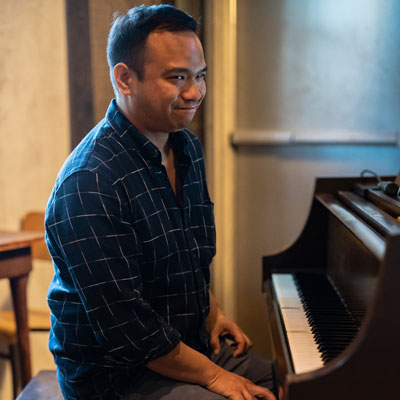
Victor Noriega is a Filipino American composer and pianist, born in Canada and raised in the Pacific Northwest, whose work explores the intersections of heritage, improvisation, and contemporary ensemble practice. His long-term project Kuyatet reimagines Filipino folk traditions and Tagalog song forms within modern jazz frameworks, balancing composed structure with open improvisation. Through this evolving body of work, Noriega examines diasporic identity, cultural memory, and intergenerational lineage as living, musical processes.
Described as possessing “the sensitivity of Bill Evans, the propulsion of Horace Silver, and the experimentation of Thelonious Monk,” Noriega’s music is known for its layered rhythmic design, harmonic depth, and seamless blending of jazz and modern classical influences. His performances bring together lyricism and drive, introspection and boundary-stretching exploration
Noriega has appeared at the Vancouver International Jazz Festival, Earshot Jazz Festival, Bumbershoot, the Filipino American Jazz & World Music Festival, and the Philippine International Jazz Festival. His commissioned orchestral work Generations, Directions, written for the Oakland East Bay Symphony, premiered in 2012 and addressed three generations of ethnicity in North America through music.
His recordings — including Stone’s Throw (2004), Alay (2006), and Fenceless (2008) — earned critical acclaim and three Golden Ear Awards from Earshot Jazz (Emerging Artist of the Year, Instrumentalist of the Year, and Album of the Year). Later projects such as 2 Trios (2013) and Horizons (2020) expanded his compositional and textural language through collaborative experimentation.
A graduate of the University of Washington’s Jazz Studies program, Noriega continues to compose, perform, and collaborate across borders and genres. His work positions jazz not simply as a style, but as a methodology — a space where tradition can be honored, reshaped, and extended into new forms.
Artist Support Program 2026
Artist Support Program 2010
Artist Support Program 2005