Margaret Jean, A Radio Portrait: Part 1
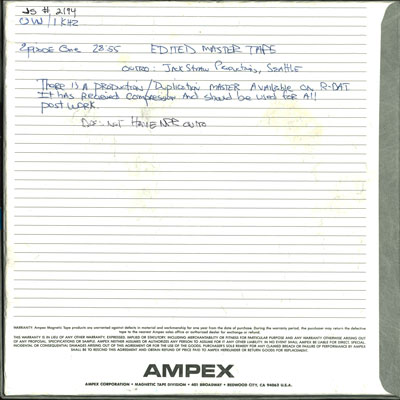
Margaret Jean, a Radio Portrait, was the first radio theater project produced by Jack Straw Productions – now Jack Straw Cultural Center – at our facility in the University District. Created by Executive Producer (now Jack Straw’s Executive Director) Joan Rabinowitz and playwright Jesse Minkert, Margaret Jean was first aired on NPR in the spring of 1991.
From the Jack Straw Productions November 1990 newsletter:
Jack Straw Plans Radio Drama
“Margaret Jean, A Radio Portrait” will be Jack Straw Productions’ first radio theater project to be produced at the new facility. JSP has received an award from the Seattle Arts Commission in partial support of this production. The history of the project is a story in itself.
Early this year Paula Swenson of Solstice Performance Arts asked Jack Straw Productions Executive Producer Joan Rabinowitz and playwright Jesse Minkert to look over a project for a radio play. Swenson had been working with a woman named Eleanor Anderson on a memorial project for Anderson’s friend, the late Margaret Jean Schuddakopf.
“As I read Eleanor’s script,” Minkert recalled, “I began to understand the admiration for Margaret Jean that drove Eleanor to tell her story. Margaret Jean was politically active from an early age. Her family had a farm in eastern Washington, was well educated, and held strong convictions about the folly of war and the value of human rights. Margaret Jean carried that tradition of political involvement through decade after decade of the Twentieth Century. She maintained it all her life, at times in the face of intense harassment.
“I saw her story as an opportunity to look back over the political turmoil of this century in this part of the country, to evoke the flavor of those times and to recreate some of the places and events through radio theater. Her personal life offers a point of contact with larger events: two world wars, the Depression, labor unrest and the Red Scare of the Fifties. These events become the context of her personal life.”
New possibilities opened up when Minkert and Rabinowitz ran into former Jack Straw board member Libby Sinclair and briefed her on the story. Margaret Jean was subpoenaed by the House Unamerican Activities Committee, and testified in the Seattle hearings in 1954. Sinclair knew another witness at those hearings, George Starkovich, who had spoken out boldly against the committee. Starkovich is still living in Seattle. Sinclair helped set up a meeting between him, Rabinowitz and Minkert, where they met Pearl Castle, who also had been at the 1954 hearings. Castle and Starkovich were gold mines of information about the history of the Left in Washington state.
This interview led Minkert to more research on the hearings, in order to recreate the sideshow atmosphere, the bullying methods of the committee, and the defiance of the witnesses, including Margaret Jean.
Anderson’s original script was an epic work with thirteen episodes of varying lengths. Minkert’s adaptation comprises two half-hour episodes. With a working script in hand, the production team of Rabinowitz, Minkert, Swenson and audio engineer Doug Haire can now begin to plan the production. After that, they can bring actors into the new studios at Jack Straw Productions and begin recording.
“Margaret Jean” will be broadcast on community and public radio stations in the Northwest beginning in the spring of 1991.